
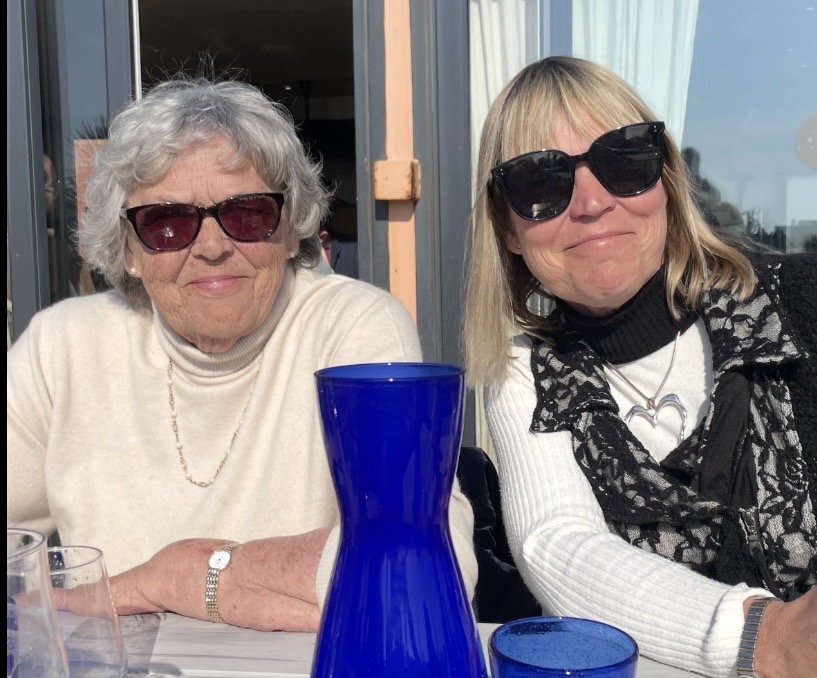
 Screenshot
What my 85 year old mum’s Marks & Spencer story tells us about loyalty, agency, age inclusive customer experience and the jobs we have not designed yet
I absolutely love Marks & Spencer so so much.
I grew up with M&S. The food, the clothes, the quality, the trust. Christmas lunch, Easter lunch, cashmere jumpers, Percy Pigs and, yes, knickers you can trust. My underwear drawer is full of M&S.
One of my favourite tops is M&S too. It is covered in diamonds. Obviously.
Marks & Spencer has woven itself through my life. But one of the things I find particularly extraordinary about the brand today is its intergenerational appeal.
My 85 year old mum loves M&S. I love M&S. My daughter loves M&S. One of my most fashionista friends loves M&S and so do her fashionista daughters in their 20s and 30s.
How many brands genuinely manage that?
Different generations, different lives, different tastes and different needs, all finding something that feels as though it belongs to them.
Usually I think M&S gets the combination of human and technology brilliantly right too. If I’m in a store and cannot find the size, colour or item I want, a colleague will often help me find it online and order it there and then.
That matters commercially because I buy it.
If I leave the store thinking I will order it when I get home, there is a pretty good chance that life will intervene and I won’t bother.
The technology supports the human experience. The human being makes the technology more useful. The customer gets what they want. M&S gets the sale.
Brilliant.
Which is why I want to tell you about my mum.
She must be one of M&S’s dream customers.
She buys cashmere jumpers regularly. Since losing a lot of weight recently, she has bought lots of new clothes there. At Christmas and Easter much of the family food and many of the presents will come from M&S.
She has a Sparks card and knows exactly what is going on with the promotions. If she spots an M&S offer, she will ring me, tell me about it and insist we go to M&S.
She shops online on her iPad too.
So this is absolutely not a story about an 85 year old woman who cannot cope with technology.
She can.
It is a story about what happens when a series of individually understandable changes begin to reduce someone’s agency.
Recently Mum discovered that she could no longer pay her Sparks card by cheque in the way she was used to. Sometimes that means I pay for something and she gives me a cheque afterwards.
That might sound like a small inconvenience.
But think about what has actually happened.
I now know what she has spent.
Why should her 61 year old daughter know how much she has spent on a skirt, a cashmere jumper or anything else?
It is her money. Her decision. Her privacy.
Then there is Click and Collect.
Mum does not drive long distances these days, she’s not able to drive to Bristol anymore, so ordering something online on her iPad and collecting it locally has worked brilliantly for her.
She can drive there herself. She goes into the shop. She sees people. She collects her parcel. She might buy something else while she is there and she certainly buys her supper.
It is part transaction, part routine and part human contact.
Last week she went to collect an order and was told that she would no longer be able to collect her clothing orders there and would need to travel further afield.
She cannot simply drive to Bristol.
So now she needs somebody else.
Again.
And then there is the café.
Recently at Cribbs Causeway we found ourselves choosing our cake from a photograph on a digital screen. It was like being at Macdonalds. If my Mum was there alone, she wouldn’t even have been able to order a coffee.
I found it difficult and I am 61.
Food is sensory. We look at it. We see the portion, the texture, the icing, the filling. We look along a counter and think, yes, I fancy that one.
We chose from the photograph. The cake arrived. We were disappointed with our choice.
It sounds tiny, doesn’t it?
But it made me think.
If you are designing a food experience around what works well on a screen rather than around how a human being actually chooses food, who are you designing for?
And if Mum were there without me, something as ordinary as going into one of her favourite places and buying herself a coffee and a piece of cake has suddenly become more difficult.
My mum is actually one of the lucky ones.
She has me.
I can drive her here, there and everywhere.
She also has three grandchildren who drive. She can spread the things she needs help with between us.
Many people do not have that.
But there is another point here that matters even when you do have a family around you.
There is a huge difference between having help available and having to ask for help.
That difference is agency.
Agency is being able to decide where you go, what you buy, how much you spend, when you collect something and whether you stop for coffee on the way home.
It is making your own decisions without needing to involve your daughter or your grandchildren.
And M&S is not simply somewhere Mum buys things.
It is one of her spaces.
One of her familiar places.
One of her third spaces.
Somewhere she knows. Somewhere she sees people. Somewhere she feels comfortable. Somewhere she feels she belongs.
At 85 there are already plenty of things in everyday life that can make you feel older, different or less included.
I do not want one of the brands where my mum has always belonged to start making her feel othered too.
What makes this particularly interesting is that M&S itself has a long history of thinking differently about age in its workforce and it has been a pioneer and led the way in this area. It removed its default retirement age in 2001, ten years before the national default retirement age was abolished, and later introduced flexible retirement.
Its current inclusion language talks explicitly about colleagues of all ages and about creating a sense of belonging. M&S also says that, to remain successful, it needs to understand and reflect its diverse customer base and the communities in which they live.
There are wonderful human examples too. In 2024 M&S celebrated Liz Osborne at its Newport store, who began working there in 1961 and was marking her 60th Christmas with the business. Her daughter had worked there and her grandson was working alongside her. Three generations within one M&S employment story.
Intergenerational alchemy.
So I do not see this as criticism of a brand getting everything wrong.
Quite the opposite.
I think M&S gets an enormous amount right.
I see an opportunity to take something it already understands about people, inclusion and belonging and look at the whole customer experience through the same lens.
And this is where my work brain kicks in.
Whose problem is this?
Is it customer experience?
Digital?
Customer Experience?
Technology / IT?
Brand?
Loyalty?
Stores?
Operations?
Accessibility?
Commercial?
Age inclusion?
Probably all of them.
Which is exactly why these kinds of problems are so interesting.
They do not necessarily sit neatly inside one functional box.
Every individual decision may make complete sense from within a particular department. The technology works. The process is efficient. The costs stack up. The system does what it is supposed to do.
But then put all of those decisions together and experience them through the eyes of one 85 year old customer.
The result can look very different.
Perhaps this is a project.
Bring together customer experience, brand, loyalty, digital, stores, operations, commercial thinking and inclusive design around one question.
How do we create an M&S experience in which a customer aged 25, 61 or 85 can all belong?
That is the kind of work I think organisations increasingly need.
Start with the problem, not the job description.
Look beyond the functional boxes.
Work out which capabilities are needed.
Bring together the right people.
Design the work around the outcome you are trying to create.
Perhaps it becomes a project. Perhaps it becomes a fractional role. Perhaps it needs an internal cross functional team. Perhaps the job does not exist yet.
The problem does.
For me, that is part of the future of work.
Some of the most valuable work may be sitting in the spaces between existing jobs and existing departments, waiting for someone to spot it.
And this particular problem matters because we should not be designing technology that reduces human agency.
Technology should increase choice.
Digital should make things easier.
Human beings and technology should complement each other.
And great customer experience should help more people feel that they belong.
M&S already demonstrates something quite remarkable.
My mum loves it.
I love it.
My daughter loves it.
My fashionista friend loves it.
Her fashionista daughters love it.
That is intergenerational alchemy.
Please protect it.
My mum has been an M&S customer for decades. She still has money to spend. She still loves beautiful clothes. She still loves good food. She still wants to make her own decisions.
And she still wants Marks & Spencer to feel like one of the places where she belongs.
This is where I come in. I can helpo you gain the spend of those 60+ consumers.
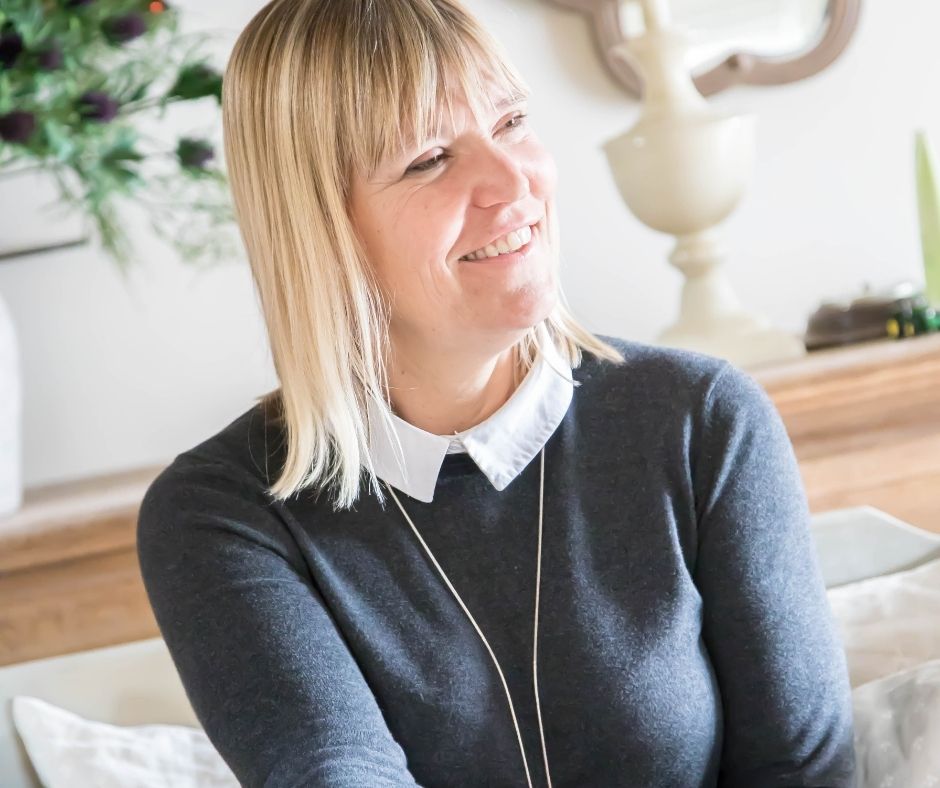
Sarah Taylor Phillips is a Future of Work strategist, speaker and founder of Career Voyage. With a background spanning AI, fmcg marketing, headhunting, interim management and entrepreneurship, she has spent more than 30 years’ connecting people, strengths and opportunities.
Today, Sarah works with organisations to attract, engage, retain, retrain and exit talent across age-diverse and intergenerational workforces from early and returning talent to experienced workers. Her work focuses on better work design, job sharing, flexible and fractional careers, knowledge transfer, rethinking retirement and reengineering role for an AI- enabled world.
At the heart of Career VoyAGE is a simple question:
How can we design work differently to make better use of the talent we already have?